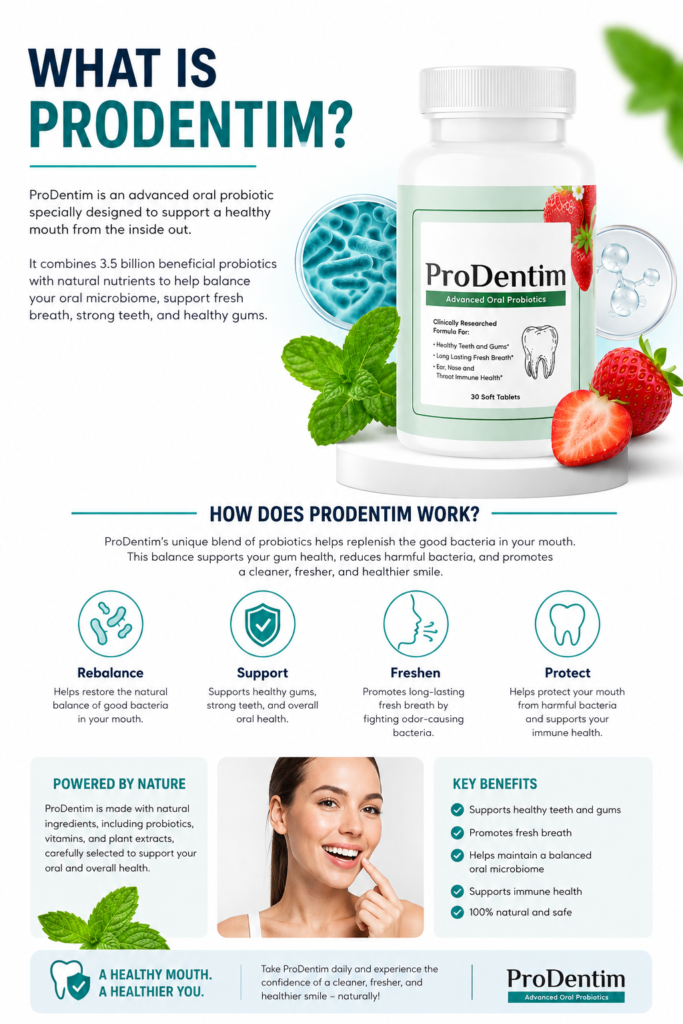
Oral probiotic supplements have become one of the fastest-growing categories in dental wellness, and ProDentim is one of the most searched names in that space. If you’ve typed “ProDentim reviews” into a search bar, you’ve probably noticed something strange: dozens of articles that all sound nearly identical, all promising the same “3.5 billion CFU” formula, and all ending with a discount link.
This article steps back from that noise to answer three separate questions: what ProDentim actually is, what the science says about its ingredients, and how to evaluate any oral probiotic — including this one — for yourself.
What Is ProDentim ?
ProDentim is a chewable tablet marketed as an oral probiotic supplement. Unlike traditional probiotics designed for gut health, ProDentim is formulated to be chewed and dissolved in the mouth, with the stated goal of introducing beneficial bacteria directly into the oral cavity rather than the digestive tract.
The manufacturer markets it as a support for gum health, fresh breath, and general “oral microbiome balance,” positioning it as a complement to — not a replacement for — brushing, flossing, and dental visits.
The listed ingredients typically include:
- Probiotic strains, most commonly Lactobacillus paracasei, Lactobacillus reuteri, Bifidobacterium lactis (BL-04), and Streptococcus salivarius strains BLIS K-12 and BLIS M-18
- Inulin, a prebiotic fiber intended to help the probiotic strains establish themselves
- Malic acid, included partly for its role in saliva stimulation
- Zinc and other trace minerals, associated with general immune and tissue support
What Does the Research Actually Say?
This is the part most “ProDentim review” articles skip. It’s worth separating two different questions: is there research on oral probiotic strains in general, and is there research on this specific branded product?
On the individual strains: There’s a genuine, published body of research on oral probiotics as a category. Streptococcus salivarius BLIS K-12 and BLIS M-18 in particular have been studied for their potential to compete with bacteria linked to bad breath and throat health, and some small clinical trials have looked at Lactobacillus reuteri strains in relation to gum inflammation (gingivitis) and plaque reduction. The general mechanism — introducing “beneficial” bacterial strains to crowd out species associated with plaque and odor — is a legitimate and active area of microbiome research.
On ProDentim as a branded formula: This is where the evidence thins out considerably. There is no independently published, peer-reviewed clinical trial testing ProDentim’s specific combination of strains, at its specific dosage, as a finished product.
The strain-level research doesn’t automatically transfer to a proprietary blend — dosage, strain viability after manufacturing and shelf storage, and combination effects all matter and aren’t addressed by citing the general literature.
This gap is common across the supplement industry, not unique to this product, but it’s the key distinction to keep in mind: “the ingredients have research behind them” is not the same claim as “this product has been shown to work.”
It’s also worth knowing that in the U.S., dietary supplements are regulated under a different framework than drugs — the FDA does not evaluate them for effectiveness before they go to market, and doesn’t verify company claims about clinical backing. That places more responsibility on the buyer to check sourcing.
Why “ProDentim Reviews” Search Results Look the Way They Do
If you’ve searched this keyword, you’ve likely noticed the review landscape has a distinctive pattern: near-identical wording across dozens of sites (“Is it a scam or legit?”, “60-day money-back guarantee,” references to tens of thousands of “verified” users), pages hosted through paid press-release services rather than editorial outlets, and even spam content occasionally appearing on unrelated university or government domains through compromised upload sections.
This isn’t unique to ProDentim — it’s the standard playbook for affiliate-marketed supplements, where publishers earn a commission on each sale generated through their link. That financial incentive doesn’t necessarily mean the product doesn’t work, but it does mean these pages can’t be treated as neutral, independent evaluations.
A genuinely useful review would disclose affiliate relationships clearly, cite specific studies rather than vague “clinically proven” language, and represent a range of outcomes rather than uniform praise.
How to Evaluate Any Oral Probiotic Product
Whether you’re considering ProDentim or a competitor, the same due-diligence questions apply:
- Are the strains named specifically? Look for named, studied strains (with a strain designation like “BLIS K-12,” not just “Lactobacillus”) rather than vague blends.
- Is the CFU count and dosage disclosed? Reputable products state the colony-forming unit count per serving, not just per bottle.
- Is there third-party testing? Independent lab verification of potency and purity (e.g., from an ISO-accredited lab) is a stronger signal than marketing copy alone.
- Where are you buying it? Reports across supplement categories — not specific to this product — describe issues with third-party marketplace sellers, including altered labels or expired stock. Buying directly from a manufacturer typically offers better recourse if something is wrong.
- What’s the return policy, in writing? A stated money-back guarantee is only meaningful if you can find the actual terms (time window, condition of return) on the seller’s own site, not just referenced by an affiliate.
The Bottom Line
Oral probiotics are a legitimate, actively researched approach to supporting gum and breath health, and several of ProDentim’s individual ingredients have real, published research behind their general use. What’s currently missing is independent, product-specific clinical evidence for the branded formula itself, and that gap is obscured by a large volume of affiliate-driven “review” content that reads as more authoritative than it is.
None of this means avoid the product — it means treat it the way you’d treat any supplement claim: check the ingredient list against the research yourself, be skeptical of any single source calling itself the definitive verdict, and remember that a supplement is a complement to dental care, not a substitute for it.
If you have ongoing gum pain, bleeding, or other symptoms, that’s a conversation for a dentist, not a chewable tablet.
This article is for informational purposes only and does not constitute medical advice. Consult a qualified healthcare or dental professional before starting any new supplement.
If you’d like to check current pricing and purchase options, you can visit this page.